astar
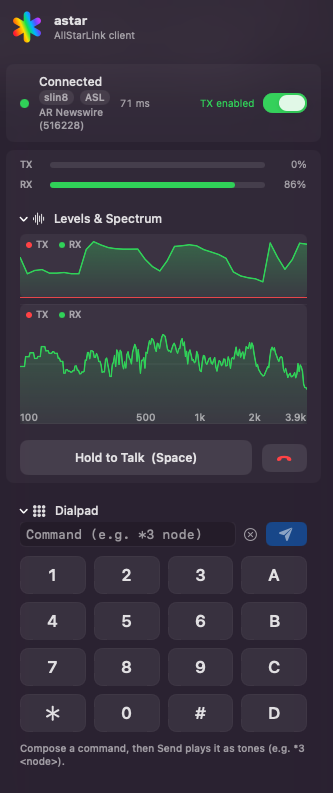
astar is a digital-voice client for AllStarLink and M17. It connects over the network as a softclient — no radio, no hotspot, no repeater in the path — and handles audio, push-to-talk, DTMF and level metering itself.
D-Star and System Fusion are in the macOS app too — DExtra to XLX/XRF reflectors, and YSF reflectors — with the AMBE+2 vocoder running on a USB dongle: a DVMEGA DVstick 30 or a ThumbDV / DV3000. Plug one in and both networks appear in the picker; there is nothing to configure.
Protocol, codec and audio handling live in one Rust engine; each platform gets a native front-end over it rather than a shared web shell.
Beta
astar is beta and moves quickly. AllStarLink is the primary target and takes
the most testing. M17 needs nothing installed — Codec 2 is linked into the
app as of 0.1.4beta. D-Star and System Fusion work, but only with a
hardware vocoder dongle attached — see
Digital voice.
Other protocols are in the tree at various stages and are not claimed as
working.
The download is Developer ID-signed and notarized, so it opens without a
Gatekeeper override. It is Apple Silicon only — a single arm64 slice — and
needs macOS 13 (Ventura) or later. On an Intel Mac,
build from source. There is no Homebrew tap, no cask, and
no App Store listing.
Networks
| Network | Transport | Voice codec | Dials | Identifies as |
|---|---|---|---|---|
| AllStarLink | IAX2 (RFC 5456), UDP 4569 | µ-law / A-law / signed-linear (8 or 16 kHz), negotiated | Node numbers | Node number, via the allstarlink.org portal |
| M17 | UDP 17000 | Codec 2 3200 | Reflector + module | Callsign |
| D-Star (needs a dongle) | DExtra, UDP 30001 | AMBE+2, on the dongle | XLX/XRF reflector + module | Callsign |
| System Fusion (needs a dongle) | YSF reflector protocol, UDP 42000 | AMBE+2 DN, on the dongle | YSF reflector | Callsign |
| NXDN (needs a dongle; receive only) | NXDNReflector, UDP 41400 | AMBE+2, on the dongle | Talkgroup on a reflector | Callsign + NXDN ID |
| DMR (needs a dongle; receive only) | MMDVM/homebrew repeater protocol, UDP 62031 | AMBE+2, on the dongle | Talkgroup + timeslot on one network's master | DMR radio ID (radioid.net) |
M17 transmits your callsign on the air; AllStarLink identifies by node number instead, and authenticates against the portal rather than a per-node secret.
D-Star voice is AMBE+2, which has no software implementation in astar: it runs on a hardware vocoder dongle, and the network appears in the client's picker only while one is attached. Digital voice covers why, and what to buy.
Where to start
-
A SwiftUI menu-bar client: an NSStatusItem that opens a dial popover, plus an optional Dock icon. macOS 13 or later. Build it from source.
-
Toolchains, the Rust workspace, the Swift xcframeworks, and the Iced client for Windows and Linux.
-
astar-lib
The engine: IAX2 framing and session state, codecs, audio I/O, PTT backends, and the multi-network station facade. Pure Rust, no UI, exposed to Swift and Python through a C ABI.
-
What was learned reverse-engineering
app_rpt's IAX2 link layer and the Web Transceiver call flow, cited to source, wire captures, or RFC 5456.
Hardware
For push-to-talk, astar drives the generic class of USB radio interfaces — serial PTT plus USB audio. The AllScan UCI150 (WCH CH343) is the reference device, not a special case. Raw USB is the default transport and needs no driver; the tty path is opt-in and on macOS needs WCH's driver. See Hardware.
D-Star and System Fusion are hardware-only. AMBE+2 has no freely licensable software implementation, so the codec runs on a dongle — a DVMEGA DVstick 30 or a ThumbDV / DV3000, either works — Codec 2 you can install, AMBE you have to own.
Architecture
All protocol, audio and PTT logic lives in the Rust crates. The front-ends are views over that engine, so a feature lands once and every client gets it, with per-platform native UI.
Platform support
| Platform | State |
|---|---|
| macOS 13+ | Supported. Menu-bar app; signed, notarized arm64 download, or build it. Intel Macs build from source. |
| Windows / Linux | In progress. The engine is cross-platform and an Iced client (apps/gui) builds and runs on both, but it is unfinished. Building it is documented; using it is not. |
| iOS | Targeted. The Xcode project builds a multiplatform target; there is no shipping iOS client. |
The macOS app is the only published binary; everything else is built from source. Day-to-day usage documentation is macOS-only for now.
Community
astar on Discord — where questions get asked, bugs get reported before they are tickets, and on-air testing gets coordinated. astar is a beta client for live amateur radio networks; hearing what broke on someone else's setup is how it stops being broken on yours.
Licence
AGPL-3.0-only for everything in the repository, except the vendored
ambe-thumbdv ThumbDV driver, which keeps its own MIT/Apache-2.0 terms. See
Licence.